
What Kings County Property Tax Records Show
Every Brooklyn parcel carries a borough, block, and lot number. That BBL is the shared key across agencies. The Department of Finance, the City Register, Buildings, and City Planning each publish their own official record. But they publish it for the same lot. Check the source date and the field labels before you conclude anything. An assessment snapshot, a recorded deed, a tax map, and a permit filing each serve a different legal purpose. The purpose depends on the record type.
| Field | What It Shows | Where |
|---|---|---|
| Assessed value | Official record detail | Official record detail |
| Market / appraised value | Official record detail | Official record detail |
| Exemptions | Official record detail | Official record detail |
| Tax bill & status | Official record detail | Official record detail |
| Taxing districts | Official record detail | Official record detail |
The borough, block, and lot number ties Kings County records together. Each agency keys its files to it. Finance, the City Register, Buildings, and City Planning all publish distinct records. They cover the same Brooklyn parcel. Field labels matter. Read them along with the source date. An assessment roll, a deed, a tax map, and a permit serve separate administrative and legal ends.
Looking Up a Kings County Tax Bill
A Brooklyn tax bill starts with the BBL. Find the borough, block, and lot, and the parcel opens across every city system. Finance, the City Register, Buildings, and City Planning each keep their own record. One shows valuation. Another shows title, permits, or zoning. Compare the source dates and labels before trusting any single number on the account.
- Follow the official portal prompts, preserve the BBL and date, and verify the result against the related city record. by address or parcel]
- Follow the official portal prompts, preserve the BBL and date, and verify the result against the related city record.
- Follow the official portal prompts, preserve the BBL and date, and verify the result against the related city record.
- Follow the official portal prompts, preserve the BBL and date, and verify the result against the related city record.
- Assessed value
- Official record detail
- Mill rate / levy
- Official record detail
- Homestead exemption
- Official record detail
- Tax lien
- Official record detail
Appealing a Kings County Assessment
An appeal in Kings County begins with the same identifier used everywhere else. The borough, block, and lot number anchors the assessment. It also anchors the deed and the tax map alike. Finance, the City Register, Buildings, and City Planning publish separate records for one parcel. Each has its own date and purpose. A valuation snapshot, a recorded deed, and a permit filing cannot be read as one document. Check the labels first.
Appeal window. Use these public records only for lawful property research. They do not replace a title search, survey, or legal advice, and they must never be used to harass anyone. with the Official record detail; missing the window means waiting for the next cycle.]
Kings County Assessment Calendar
New York City fixes January 5 as its taxable-status date. The tentative assessment roll comes out in January. The final roll follows in June. The Notice of Property Value spells out the tax class, estimated market value, assessed value, and exemptions, plus the route for a challenge. Tax Commission deadlines vary by class. Use the current official calendar rather than an old notice.
The city applies a 6 percent assessment ratio to Class 1 and 45 percent to Classes 2 through 4. Caps and phase-ins can push assessed value in directions market value does not go. Exemptions lower taxable assessed value, while abatements cut the tax after it is calculated. Those distinctions matter. Two figures on one parcel card are rarely interchangeable.
Brooklyn Tax Liens Explained
A New York City lien sale hands a municipal debt to an authorized buyer. Collection rights go with it. It does not sell the real estate. Title does not move. Confirm any list entry against the current DOF account. Then trace any Supreme Court action and later ACRIS instrument. A late charge, lien-sale eligibility, and a filed foreclosure are all separate events. An auction notice and a recorded referee deed are separate events too.
Read a Kings County Assessment
The official final-roll example shows the assessment fields that feed Brooklyn property tax records.
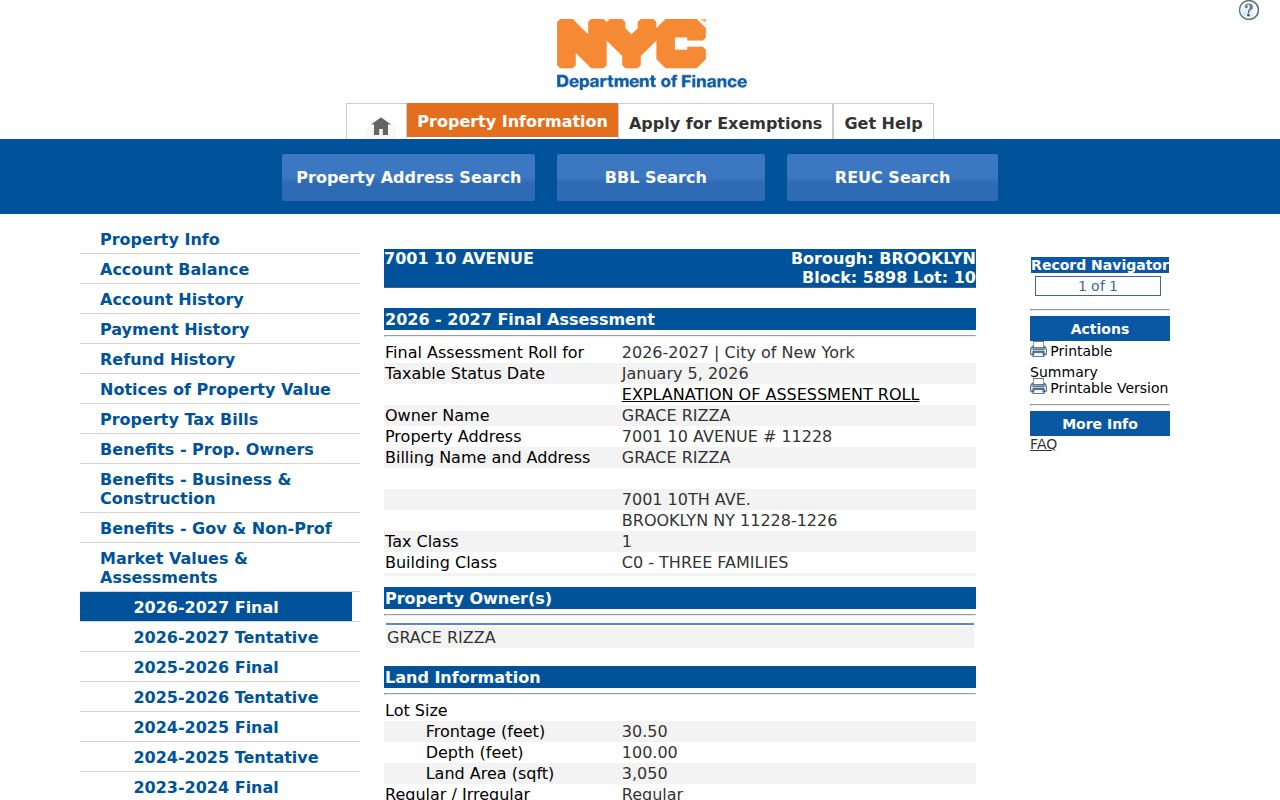
The official assessment display keeps market estimates, assessment limits, exemptions, and taxable value distinct before any bill is calculated.
Kings County Tax Bill Timing
Brooklyn bills run on quarterly or semiannual schedules set by assessed value under current DOF rules. A property account can display bills, payments, balances, notices, and benefit details. Note the bill period when you look. Payments, adjustments, exemptions, and corrections can all change the account after you save a result.
The roll and the bill are cousins, not twins. The roll reports valuation and taxable status. The bill applies rates, exemptions, abatements, and account activity. A recorded deed can change ownership while an older charge survives, and a billing address may name a recipient rather than the parcel itself.
Appeal a Brooklyn Assessment
The Tax Commission hears challenges to assessed value. DOF also offers routes to review or correct specified errors. Filing dates depend on tax class, and the current official forms control. Build the appeal file with care. The Notice of Property Value, tax class, market and assessed values, exemption fields, comparable evidence, filing confirmation, and the agency response all belong in it.
The assessment ratio does real work. Class 1 carries 6 percent. Classes 2 through 4 carry 45 percent. Statutory caps and phase-ins can limit annual swings. Effective market value and transitional math may diverge from a simple ratio. Valuation and title are separate systems. Disagreeing with a market estimate is never fixed by editing a deed.
Kings County Exemptions
DOF runs property-tax benefits for qualifying owners. These cover seniors, people with disabilities, veterans, clergy, and other statutory categories. Each program sets its own eligibility, evidence, deadline, and renewal rules. An exemption trims taxable assessed value. An abatement trims the tax after calculation. Neither one touches the recorded deed or the city's estimate of market value.
Check the parcel result for current benefit fields. Then follow the official status or application route. Age, name, address, or past benefits prove nothing about eligibility. If a benefit seems missing, compare the application year, the taxable-status date, the notice, and the final roll. Request a correction after that.
Brooklyn Assessment Archives
Brooklyn's older tax history sits in two places. The Department of Finance posts final assessment-roll archives covering 2009 forward. Files are split by tax class, with record layouts included. Pull the same BBL across several fiscal years. You can watch an owner label, market estimate, exemption, or class shift over time. The Municipal Archives reaches much deeper. Its holdings include Brooklyn tax assessments from 1899 through 1946. Broader assessed-valuation records run from 1789 through 1979. That is a remarkable span for parcel research.
Treat historical rolls with the same care as current ones. They are dated tax records, not deed indexes. A handwritten ledger can carry transcription errors. It may also show old ward lots, former street numbers, an owner and occupant, house counts, and a value. Cross-check the year and property description. Then use directories, maps, and deeds before folding any name into a title chain.