
How a Kings County Property Search Works
Brooklyn organizes its property records around one shared identifier. The borough, block, and lot key, known as the BBL, links everything. Four city offices publish the records you will use most. They are Finance, the City Register, Buildings, and City Planning. Each keeps a distinct official record for the same tax lot. One is an assessment snapshot. Another is a recorded deed. A third is a tax map line, and a fourth is a permit filing. They serve different legal purposes. So read the source date and the field labels before you trust any single answer.
- Follow the official portal prompts, preserve the BBL and date, and verify the result against the related city record.]
- Follow the official portal prompts, preserve the BBL and date, and verify the result against the related city record.
- Follow the official portal prompts, preserve the BBL and date, and verify the result against the related city record.
- Follow the official portal prompts, preserve the BBL and date, and verify the result against the related city record.
- Follow the official portal prompts, preserve the BBL and date, and verify the result against the related city record.
What a Kings County Property Record Shows
A single Brooklyn parcel can appear in four different systems, and none of them alone is the whole story. The Finance Department posts the assessment and tax roll. The City Register files the deed and mortgage records. Buildings handles permits, and City Planning draws the zoning map. What joins them is the borough, block, and lot number. An appraisal figure on one record does not match the consideration on a deed, and neither matches a permit value. Check the date on every record. Check the label on every field. Then draw your conclusion.
| Owner of Record | Official record detail |
|---|---|
| Situs / Mailing Address | Official record detail |
| Parcel Number (APN) | Official record detail |
| Assessed / Market Value | Official record detail |
| Legal Description | Official record detail |
| Last Sale | Official record detail |
Each office in Brooklyn answers a different property question. The tax roll says what a lot is assessed at. The deed records say who conveyed it and to whom. The plat and zoning layers say what may be built there. The permit file says what actually was. All of it keys off the borough, block, and lot identifier. That one number unlocks records from Finance, the City Register, Buildings, and City Planning. A recorded deed, an assessment, and a permit serve separate legal purposes. Always read the date and the field names on the record you pull. The identifier is the thread.
Search by Address, Owner, or Parcel
Three entry points open most Brooklyn lookups. You can search by a street address, an owner of record, or the parcel number itself. The address feels natural, since you usually know where the building stands. Owner names work when the deed records are the goal, though common surnames return crowds. The parcel number, called the BBL, is the sharpest tool of the three. Every city system indexes by it. Whichever you choose, the same rule applies. The Department of Finance, the City Register, Buildings, and City Planning each publish their own record. Each record carries its own date and purpose. Match the parcel across sources rather than trusting the first result.
| Search Key | Best For | Where It Works | Watch Out |
|---|---|---|---|
| Address | Official record detail | Official record detail | Official record detail |
| Owner name | Official record detail | Official record detail | Official record detail |
| Parcel number | Official record detail | Official record detail | Official record detail |
Not a title search. Use these public records only for lawful property research. They do not replace a title search, survey, or legal advice, and they must never be used to harass anyone.
Kings County Search Fields
The Property Information Portal takes nearly any identifier you have. Enter an address, a Brooklyn block and lot, the block alone, a condominium number, a co-op development number, a REUC identifier, an air lot, or a subterranean lot. The address is the easy first step. The BBL is the stronger one. You can carry it into ACRIS, ZoLa, and DOB without ambiguity. From the result, save the tax class, building class, owner label, billing address, physical address, assessment year, and map-history notes.
ACRIS adds a second layer of query fields. Search by party name, parcel identifier, document type, CRFN, transaction number, reel and page, or lien file. A party query lets you set last name, first name, middle initial, suffix, business name, date range, party role, borough, and document class. Some older index entries list first and last names in reverse order. Try both ways.
What Brooklyn Results Mean
A Brooklyn parcel card packs in a lot: buildings, year built, stories, units, lot size, zoning, assessments, exemptions, recent sales, mortgages, and tax-map history. The sales and mortgage panels are convenience views. They are not the full deed records. Open the matching instrument in ACRIS and compare the BBL, parties, document date, recorded time, amount, CRFN, and references before relying on any figure.
A blank result is narrow evidence, not a final answer. Retry with a BBL, a name variant, a business name, a former lot number, a wider date range, or a referenced filing number. For high-volume work, use NYC Open Data. Automated ACRIS scraping runs against a published bandwidth limit.
Search Brooklyn by BBL
An address alias or a stray unit number can pull the wrong lot. The parcel route avoids that. Brooklyn's borough digit is 3, followed by block and lot, and the leading zeroes matter. ACRIS demands borough, block, and lot together. Enter lot 0000 with no unit, and you may retrieve an entire block. Condominiums, co-ops, air lots, subterranean lots, and REUC property call for special modes in the Property Information Portal. The ACRIS parcel-search instructions lay out the borough, block, lot, unit, date, and class controls.
The form itself shows why a saved BBL beats a free-form Brooklyn address for parcel-level work.
Search Kings County Owner Names
Owner names live in ACRIS. The current Property Information Portal does not offer owner name as its main query. For individuals, fill in last, first, middle initial, and suffix. For entities, use the business field. Narrow the results with dates, party role, Brooklyn borough, and document class. A hit may name a buyer, a seller, a lender, a fiduciary, or a life tenant. Verify the parcel grid before deciding who the owner of record is. The ACRIS party-name help covers partial matches. It also explains the reversed first and last names in some old entries.
The instructions support a deliberate search instead of treating one spelling as complete.
Read a Brooklyn Parcel Card
A good parcel card keeps its roles separate. One note splits Property Owner, Billing Name and Address, and Property Address. The card also carries the BBL and tax class. It adds building class, lot and building measurements, and units. Market estimate, assessed values, exemptions, and roll year round out the card. Read them as distinct facts. A billing agent may sit out of state. But the assessed owner can be a Brooklyn LLC. That alone establishes neither residence nor possession. The official LLC assessment example displays separate owner and billing fields.
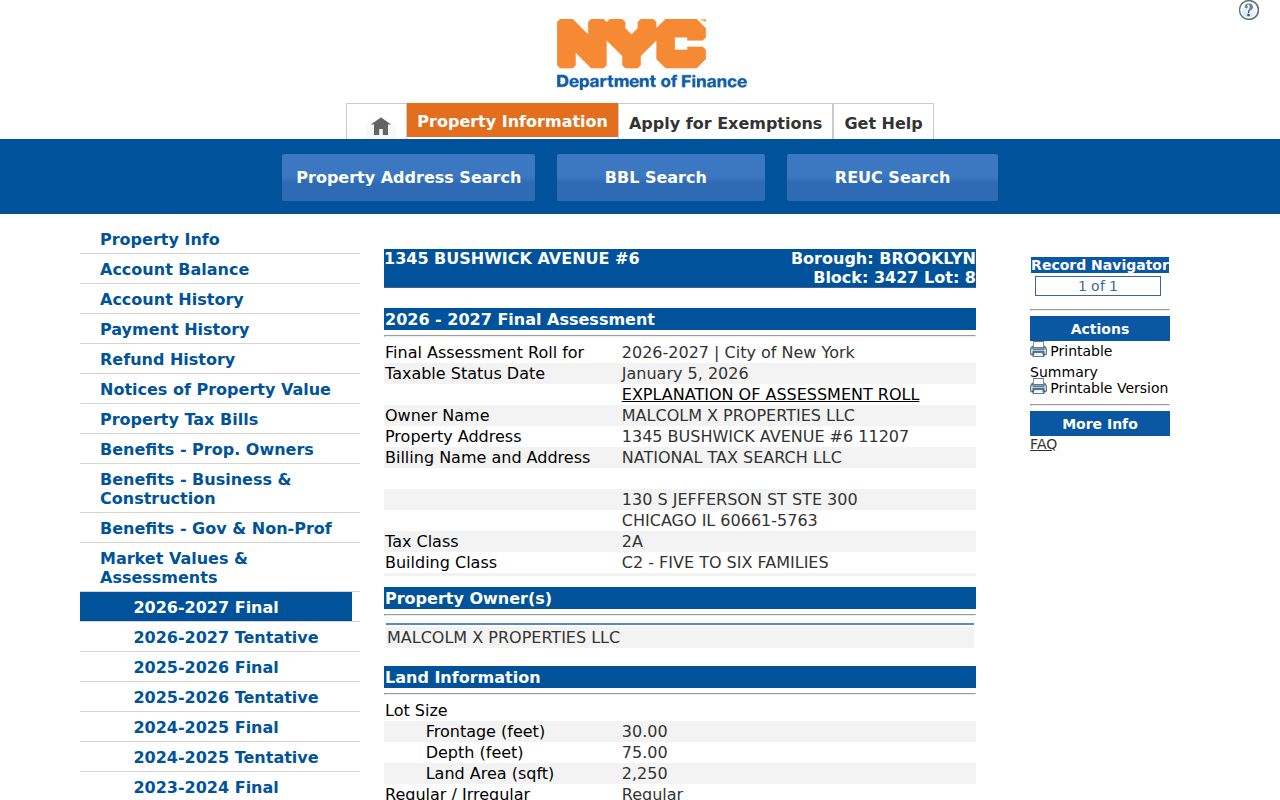
The result shows why owner, mail destination, and situs must remain separate facts.
Kings County Search Fallbacks
Skip the portal and go to the custodian when the online route stalls. The Brooklyn City Register handles current research and certified copies. It also holds microfilm. Pre-1966 Brooklyn books that moved are held at the Queens research library. The Department of Finance publishes assessment files and archives from 2009 forward. DOB requests pull older folders, plans, microfilm, and index cards. FOIL can reach agency records that fit a reasonable description and sit outside any online index. It creates no new research product.
Write down the exact query before you judge it. Note the borough, date span, class, and fiscal year. Add the search date. A null result means only that one index and one spelling came up empty. Try a former BBL or a reversed name. Try an entity variant, another reel and page, or the right counter collection.
Connect Kings County Portals
The BBL is the junction. Yet every portal layers its own identifier on top of it. ACRIS contributes the CRFN, Document ID, reel and page, transaction number, and map references. DOB adds BIN and a job number. PIP supplies the assessment year plus tax-map change history. A condominium brings a declaration, base lot, units, and tax lots into the mix. A durable research note captures all of these along with the access date. That way, a portal redesign cannot erase the trail.
Start in PIP whenever the input is an address. Confirm the physical parcel there, then carry the BBL into ACRIS. Treat the Sales and Mortgages panels as a quick inventory only. PIP itself points to ACRIS as the complete official document source. From there, move to the tax map for predecessor lots. Use DOB for building history, and ZoLa for zoning and historic overlays.
Brooklyn Address Search Problems
An address is a weaker key than people assume. It can change, omit a unit, name a common place, or sit atop a building that spans several lots. A condo address may return many units at once. Air and subterranean lots share surface context without behaving like ordinary tax parcels. A former factory, waterfront site, or urban-renewal block may carry a modern address that never appears in the older deed chain.
Compare evidence when the address route looks shaky. The map polygon, block and lot, building class, dimensions, cross streets, and legal description should line up together. PIP map history can expose predecessor lots. Historic directories, Sanborn sheets, assessment ledgers, and the Borough President's Topographical Bureau help reconcile an old street name. Never silently normalize a historical address. Record both forms instead.
Kings County Record Limits
Public records have edges worth knowing. The assessment owner is a tax-roll fact, nothing like a title opinion. A recorded deed proves an instrument was accepted and indexed. It does not settle every legal issue there. A tax-map line is not a survey. A sales amount can be nominal, or reflect a transfer outside the open market. A permit shows a filing or agency action, never present ownership.
Purchase, litigation, estate, fraud, and boundary questions need the full picture. Reconcile the deed chain, its references, and court or probate papers. Weigh map history, tax status, and survey evidence alongside them. A title professional, attorney, or licensed surveyor can help. They answer the questions these indexes were never built to decide.
Document a Kings County Search
A reproducible property search records far more than a final name. Save the address exactly as typed. Also save the ten-digit BBL, borough selection, party spelling, entity variant, date span, document class, fiscal year, and access date. In ACRIS, keep execution and recording dates separate. Label each DOF roll as tentative or final. For DOB, state whether the answer came from BIS or DOB NOW. For maps, separate the current view from historical alteration material.
A good log turns a dead end into evidence. It stops a later reader from confusing a billing address with a situs, a document amount with a sale price, a tax owner with guaranteed title, or a map polygon with a surveyed boundary.