
Kings County Deed Records and What They Show
The borough, block and lot is the shared key. Every office in the Kings County system files its records under that one number. Finance posts the assessment and tax roll. The City Register keeps the recorded deeds. Buildings tracks permits and City Planning maintains the tax map, and because each record serves a different legal or administrative purpose, check the source date and field labels before treating an assessment snapshot, a deed, a tax map, and a permit filing as the same thing.
| Deed Type | What It Does | Common Use |
|---|---|---|
| Warranty deed | Official record detail | Official record detail |
| Quitclaim deed | Official record detail | Official record detail |
| Grant / special warranty | Official record detail | Official record detail |
| Trustee / executor deed | Official record detail | Official record detail |
| Tax deed | Official record detail | Official record detail |
The borough, block and lot anchors everything in Brooklyn. That BBL links the Finance assessment to the recorded deed. The tax map and permits use it too. Four Kings County agencies publish four different official records under it. An assessment snapshot, a recorded deed, a tax map, and a permit filing each do different legal work, so read the source date and field labels before you lean on any single one.
The Kings County Grantor-Grantee Index
A grantor-grantee index works from names rather than parcels. In Kings County the borough, block and lot still ties every record together. The index lists who conveyed and who received. Each entry leads to a recorded deed. Finance, the City Register, Buildings, and City Planning each publish their own official record, so read the source date and field labels before drawing conclusions, since an assessment snapshot, a recorded deed, a tax map, and a permit filing carry different legal weight.
- Follow the official portal prompts, preserve the BBL and date, and verify the result against the related city record.
- Follow the official portal prompts, preserve the BBL and date, and verify the result against the related city record.
- Follow the official portal prompts, preserve the BBL and date, and verify the result against the related city record.
- Follow the official portal prompts, preserve the BBL and date, and verify the result against the related city record.
- Grantor
- Official record detail
- Grantee
- Official record detail
- Chain of title
- Official record detail
- Book/Page vs Instrument #
- Official record detail
Getting a Copy of a Kings County Deed
To get a copy, start with the parcel. Kings County records all hang on the borough, block and lot number. The recorded deed itself sits with the City Register. Other agencies publish under the same key. Finance handles assessments, Buildings handles permits, and City Planning keeps the tax map, so check the source date and field labels on each, because an assessment snapshot, a recorded deed, a tax map, and a permit filing do different legal work.
Recorded, not guaranteed. Use these public records only for lawful property research. They do not replace a title search, survey, or legal advice, and they must never be used to harass anyone.
Brooklyn Deeds Before 1966
ACRIS images only go back to 1966. Kings County deed history runs deeper. Brooklyn land books, grantor and grantee indexes, and filed maps reach much earlier, and the pre-1966 volumes sit at the Queens City Register Research Library, with microfilm or microfiche also usable at the Brooklyn office. Come prepared. Bring the current BBL, old lot numbers, name variants, an estimated year, and any reel, page, book, or later reference you hold.
Old town names help too. Flatbush, Flatlands, Gravesend, New Lots, New Utrecht, Bushwick, and Williamsburgh all appear in early records because Brooklyn expanded before the 1898 consolidation. Those names mark an earlier records geography. They do not describe a different county today.
Kings County Recorded Document Alerts
The Department of Finance offers a free alert service. It is called Notice of Recorded Document. You register a BBL or an address. Email or text notices follow once a Kings County document is recorded. An alert is a warning, not proof of fraud or validity. Review the ACRIS image, parties, parcel, and references, then contact the City Register or an attorney when an instrument is unexpected.
Read an ACRIS Deed Detail
An ACRIS detail page packs in a lot. Document ID, page count, type, execution date, amount, correction messages, CRFN, legacy reel and page, recorded time, parties, parcels, references, and remarks all appear, along with the image itself. The parcel grid matters as much as the names. A common name can attach to unrelated filings. So can a lender or entity. And the stated amount is not always a sale price.
The official ACRIS detail guide explains each field used to evaluate Kings County deed records.
The view supplies the identifiers needed to cite a deed and follow its references.
Kings County Deed Search Modes
ACRIS offers several ways in. Party Name works when you know a signer, and the Kings County parcel identifier takes the BBL. Document Type narrows the instrument. Document ID or CRFN locates modern filings, Transaction Number supports processing research, and Reel and Page is the legacy route for older volumes. UCC and federal-lien file numbers serve filings in those classes, and while a Document ID exists during processing, CRFN remains the permanent recorded-file number.
Start with the newest deed on the lot. Record grantee, grantor, execution and recording dates, CRFN, parcel, and references, then find that grantor as grantee on the earlier acquiring deed. Follow corrections, estates, and predecessor lots, not just names.
Brooklyn Deed Types in Context
A deed label describes the instrument, not the title. A correction deed may fix a name or description. An executor, administrator, or fiduciary deed reflects the authority of an estate. A referee deed may follow foreclosure. Easements, leases, declarations, condominium instruments, and filed maps can change rights. No sale needs to take place.
Mortgages, assignments, consolidations, modifications, spreaders, and satisfactions form a financing trail. A satisfaction must cite the right mortgage and lot. A notice of pendency signals litigation whose present status comes from the court docket. And never claim a Kings County parcel is lien-free after one deed query.
Copies from the City Register
Inspecting the index and the images costs nothing. Certification is a separate step, though. The City Register's workflow takes you through the image, the cart, the certification option, the delivery details, and the copy charge, which sits apart from any recording charge. For current research, copies, and Brooklyn microfilm, go to the Brooklyn City Register at 210 Joralemon Street during posted weekday hours. Confirm those hours before you travel. Records held at Queens work best when you arrive prepared, so bring the current and former BBLs, name variants, an approximate year, and any reel, page, book, or later reference you have.
Kings County Mortgage Trail
Search the lot broadly in the Mortgages and Instruments class. The trail should include the original mortgage. It should also cover every assignment, consolidation, spreader, modification, extension, satisfaction, and release. Match the borrower, lender, amount, BBL, execution date, recording date, CRFN, and references carefully. Names alone are not enough. A satisfaction with a different parcel clears nothing. Federal tax liens, fixture filings, mechanics' liens, judgments, easements, restrictive declarations, and notices of pendency follow their own release paths. Some follow their own disposition paths instead. Classify the record first. Some selected liens and court notices belong elsewhere. They go to the Kings County Clerk or the court file instead. Ordinary deeds and mortgages still go to the City Register.
Kings County Chain Breaks
A chain can look broken after a lot merger, apportionment, condominium conversion, estate transfer, foreclosure, or correction. Start with the PIP tax-map history. It may hold an older BBL. A deed or map CRFN often sits there too. Follow the ACRIS references, and search the parties in both name orders. A fiduciary or referee calls for WebSurrogate or the Supreme Court. The break is usually a changed identifier or authority document.
Old Brooklyn labels matter. A book may name Flatbush, Flatlands, Gravesend, New Lots, New Utrecht, Bushwick, or Williamsburgh. Carry that town or ward clue into City Register books, assessment ledgers, directories, and maps. Compare legal descriptions, adjoining owners, consideration, and later references before treating two same-name parties as one person.
Kings County Deed Alerts
NYC's notification service is free. It takes property and delivery details. The official Notice of Recorded Document form shows the BBL, address, and alert options, and the registrant learns of each new recording.
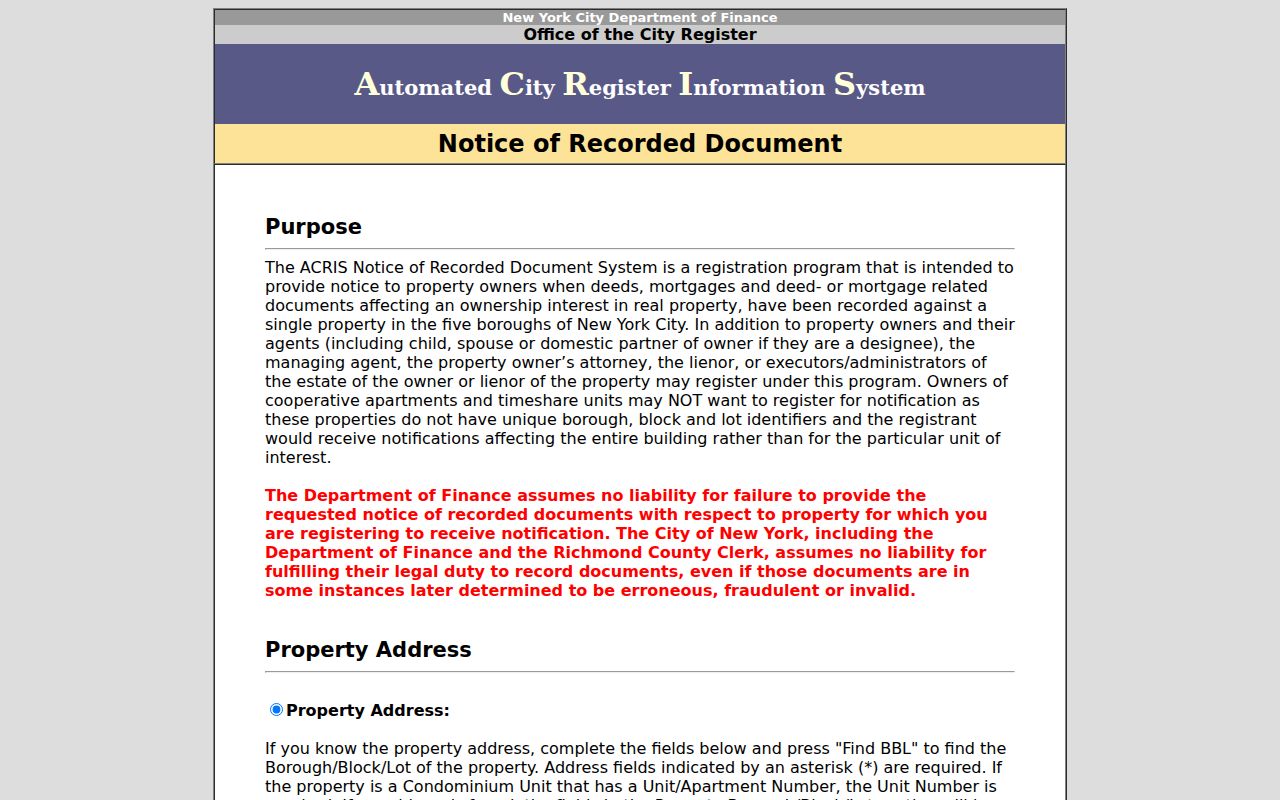
An alert is a monitoring tool only, and it should lead to the recorded image and a direct City Register review. Deed-fraud guidance also recommends periodic ACRIS review. If a filing is unknown, save its CRFN and image, compare the signatures and parcel, and act promptly. Do not accuse a party yet. Corrections, mortgages, and estate documents trigger notices too.
Historic Brooklyn Deed Evidence
Directories, assessment ledgers, and Sanborn maps can help you locate an old Brooklyn deed. None of them replaces the deed itself. A directory may identify a dated occupant and address. An assessment ledger may supply an owner, ward lot, building description, and value. A Sanborn sheet may show a footprint and use. Weigh each clue against the grantor-grantee index. Check it against the legal description, adjoining owners, the consideration, and the next instrument in the chain.
Preserve the source title, year, and page. Record the ward or town, street form, and any old lot number. A book can be damaged, missing, or off site. When it is, state the gap plainly and move laterally. Maps, tax rolls, probate, court files, directories, and later deed references all keep the trail alive. A transparent gap beats an invented former owner.
Cite a Kings County Deed
A durable deed citation needs the City Register, the document type, the parties, the execution date, the recorded date and time, the Brooklyn BBL, the CRFN or legacy reel and page, and the image access date. Referenced instruments and remarks count too. Include them when they affect the chain. Deep portal links expire. The citation still works, and the City Register counter can locate the same record for certification.