
What the Kings County Current Owner Record Shows
Every Brooklyn parcel hangs on one shared key. That key is the borough, block, and lot number, or BBL. Four agencies publish official records against it. The Department of Finance posts the assessment. The City Register records deeds. Buildings handles permits, and City Planning maintains the tax maps. Each record answers a different question. Check the source date and field labels before trusting any single name. An assessment snapshot, a recorded deed, a tax map, and a permit filing serve different legal purposes.
| Owner of Record | Official record detail |
|---|---|
| Vesting / Tenancy | Official record detail |
| Mailing Address | Official record detail |
| Situs Address | Official record detail |
| Deed Reference | Official record detail |
| Ownership Since | Official record detail |
In Kings County, the borough, block, and lot tie everything together. That number links an assessor entry to its deed, permit, and tax map. Four offices publish their own records under it. Finance keeps the roll. The City Register keeps deed records. Buildings tracks permits, and Planning draws the maps. Before drawing a conclusion from any one of them, read the date on the record and the labels on its fields. Each document carries different administrative weight.
Confirming the Current Owner in Kings County
To confirm a Brooklyn owner, work from the parcel number. The borough, block, and lot connects every office that keeps Kings County property records. Each agency answers a different question. Finance issues the assessment roll, and the City Register files deeds. Buildings logs permits, and City Planning maps the parcel. A recorded deed, a tax snapshot, a plat, and a permit filing are not interchangeable. So weigh the source date and field labels of each before settling on a name.
- Follow the official portal prompts, preserve the BBL and date, and verify the result against the related city record.
- Follow the official portal prompts, preserve the BBL and date, and verify the result against the related city record.
- Follow the official portal prompts, preserve the BBL and date, and verify the result against the related city record.
- Follow the official portal prompts, preserve the BBL and date, and verify the result against the related city record.
- Owner of record
- Official record detail
- Vesting
- Official record detail
- Registered agent
- Official record detail
Reaching a Kings County Property Owner
Need to reach a Brooklyn owner? Start with the parcel. The borough, block, and lot opens every agency file that matters. Finance shows the roll owner, and the City Register holds the deed. Buildings lists permits, and City Planning maps the lot. An assessment snapshot, a recorded deed, a tax map, and a permit filing carry different legal weight. So read the date and labels on whichever record you use for contact purposes.
Lawful use. Use these public records only for lawful property research. They do not replace a title search, survey, or legal advice, and they must never be used to harass anyone.
Kings County Roll Freshness
The NYC assessment roll is a dated tax record. Its taxable-status snapshot falls on January 5. That explains why a freshly sold Brooklyn lot can still carry the old name. New York City publishes no fixed closing-to-roll update interval. Name the roll year and your search date rather than promising a number of days. Check ACRIS for the most recent conveyance on the same BBL. Keep the execution and recording dates apart. They serve different purposes. Compare the parcel grid with the deed image. Do not treat the named grantee as the stronger current-owner signal before that.
Brooklyn Mailing and Situs Fields
Three fields sit side by side on the DOF record. Property Owner names the owner of record on the roll. Billing Name and Address shows where the tax bill travels. Property Address is the situs. An out-of-state billing address can point to an agent rather than a residence, a distinction that matters most for LLCs, condominiums, estates, and managed parcels.
See a Brooklyn LLC Owner
The official assessment example from the Department of Finance shows an LLC owner of record with a separate billing recipient and mailing address on the Brooklyn parcel.
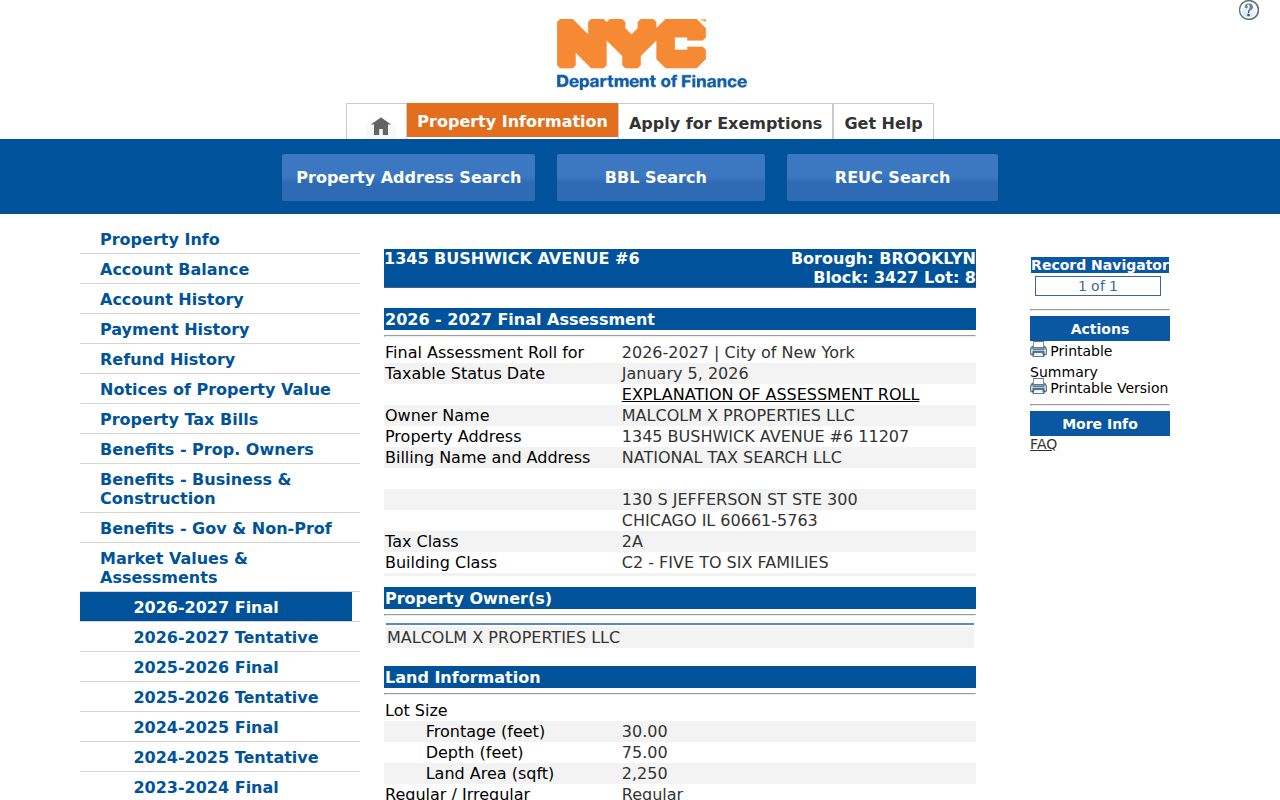
The fields stay distinct. On the current roll record, the owner entry, the billing entry, and the Brooklyn situs each carry their own separate information.
Recent Sales and Owner Changes
PIP's Sales and Mortgages panels flag recent recordings. The portal calls them informational views of ACRIS data. Use the listed Document ID to pull the official instrument. Compare the deed date with the recorded time. Signing and recording are separate events. A sale can close before the roll catches up. A deed can also land after the tax snapshot. No official source publishes a fixed closing-to-roll lag for Brooklyn, so state the evidence instead: the assessment year, the January 5 status date, the deed execution date, and the recording date. That beats promising updates within an invented number of days.
Kings County Change Alerts
The Notice of Recorded Document program watches a BBL or address for new filings. Alerts arrive by email or text. An owner or any interested registrant can sign up. The alert itself changes nothing. It will not update the assessment roll, block a deed, or settle validity. It simply tells you to inspect the new ACRIS record. Co-op units can trigger broader building notices, since shares are not ordinary separate real-property tax lots. Condo units may carry their own unit tax lots. Pick the right property structure before reading an alert or hunting for the current owner.
Verify a Kings County Entity
When the roll names a company, copy its punctuation and suffix exactly. Then search the New York Department of State business database. The entity result may list a legal name, organization date, jurisdiction, county, status, service-of-process address, and registered agent. Those fields separate look-alike names. They also explain an out-of-area mailing address. They cannot prove who holds every economic interest. Go back to the deed after the entity search. The recorded grantee name, BBL, legal description, execution date, recording date, and CRFN tie the company to the parcel. Remember that a registered-agent address is not the property situs, and an inactive entity status alone does not prove title transferred away.