
The Values on a Kings County Property Record
Brooklyn property records share one key. The borough, block, and lot number links every Kings County parcel across agencies. Finance posts the tax roll. The City Register records deeds, Buildings files permits, and City Planning maintains the tax map. An assessment snapshot, a recorded deed, a plat, and a permit filing serve different purposes, so read each source date and field label before drawing a conclusion.
| Value | What It Is | Where |
|---|---|---|
| Assessed value | Official record detail | Official record detail |
| Market / appraised value | Official record detail | Official record detail |
| Last sale price | Official record detail | Official record detail |
| Land vs improvement | Official record detail | Official record detail |
Kings County property records hang on one number. Each Brooklyn parcel has a borough, block, and lot. That key works at every agency. Finance publishes the assessment and tax roll, the City Register keeps deed records, Buildings files permits, and City Planning maintains the tax map. Check the source date and field labels, because an assessment snapshot, a recorded deed, a plat, and a permit filing serve different legal purposes.
Looking Up a Kings County Property Value
One identifier rules them all in Kings County. It is the borough, block, and lot. Every agency indexes its property records with it. Finance publishes the assessment and tax roll, the City Register keeps deed records, Buildings files permits, and City Planning maintains the tax map. Since a snapshot, a deed, a plat, and a permit filing serve different jobs, read the field labels and dates before trusting a comparison.
- Follow the official portal prompts, preserve the BBL and date, and verify the result against the related city record.
- Follow the official portal prompts, preserve the BBL and date, and verify the result against the related city record.
- Follow the official portal prompts, preserve the BBL and date, and verify the result against the related city record.
- Follow the official portal prompts, preserve the BBL and date, and verify the result against the related city record.
- Assessed value
- Official record detail
- Market / appraised value
- Official record detail
- Level of assessment
- Official record detail
What a Kings County Assessor Value Is Not
Kings County parcels answer to one number. The borough, block, and lot is that key. Finance, the City Register, Buildings, and City Planning all index their property records with it. Each publishes a distinct record. Because an assessment snapshot, a recorded deed, a plat, and a permit filing serve different purposes, read the field labels and source dates before comparing any two figures.
Value vs price. Use these public records only for lawful property research. They do not replace a title search, survey, or legal advice, and they must never be used to harass anyone.
Brooklyn Assessment Ratios
Brooklyn assessment math starts with a ratio. The City assesses Class 1 at 6 percent of market value and Classes 2 through 4 at 45 percent, caps and phase-ins included. That is why an assessed value is not a sale forecast. The parcel card holds more figures: land value, total estimated market value, market assessed value, a limitation or transitional value, exemptions, and taxable assessed value. Read the label and fiscal year with each number.
Exemptions only cut the taxable figure. They leave the City's market estimate untouched. A deed's document amount can be nominal, or serve a purpose other than reporting an arm's-length price. Rolling-sales files and the ACRIS deed image give better transaction context. Neither one is a private appraisal.
Recent Kings County Roll Trends
Brooklyn's FY2026 roll arrived in January 2025. DOF reported Class 2 market value up 9.4 percent, Class 2 rental market value up 15.3 percent, and Class 4 up 6.3 percent. Those borough-wide changes are dated context only. They cannot establish the condition, income, rights, or likely sale price of a single parcel.
View a Kings County Value Record
This official DOF assessment example lists land, total market, assessed, limitation, exemption, and taxable values alongside the roll year. Every figure wears its label.
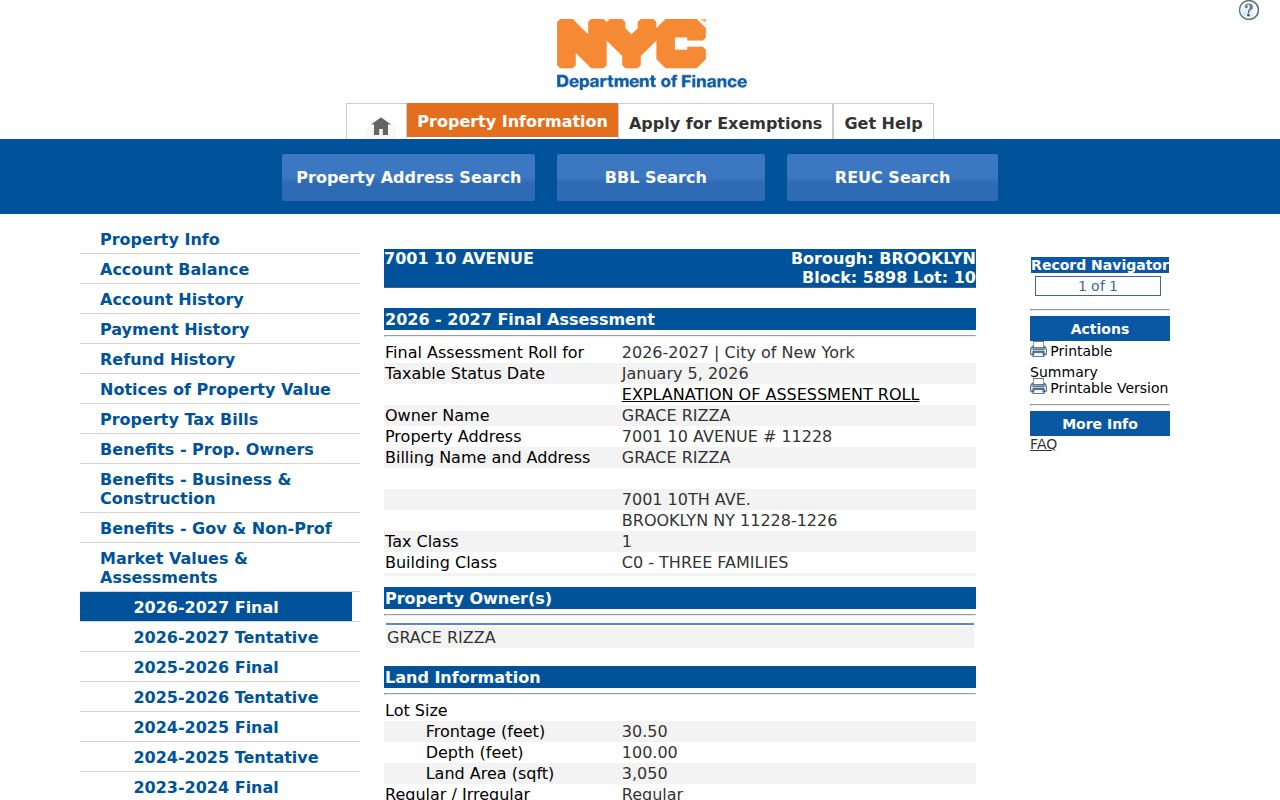
Tax value is not sale price, the field labels show.
Recorded Brooklyn Sale Prices
PIP can display recent sales. DOF publishes rolling and annualized sales files. ACRIS shows the underlying deed with its document amount. Line up the transfer date, recording date, BBL, property type, and parties. Context matters. A nominal amount, family transfer, or fiduciary deed may not reflect an open-market price. The same is true of a foreclosure or multi-parcel deal.
Rolling sales locate nearby deals. They do not value the subject parcel. Condition, rights, income, unit mix, and terms can all differ. Keep the source date and confirm the row you picked against the recorded deed.
Exemptions and Taxable Value
An exemption trims taxable assessed value under its program rules. It leaves the market estimate alone. It cannot rewrite a recorded sale price on the deed either. An abatement usually applies after the tax calculation. That is why market, assessed, exemption, and taxable figures can disagree. Bill figures can disagree too, on one property record.
Work from the final roll for the fiscal year in question. Use the Notice of Property Value as well. A figure that looks wrong often has a plain cause. Check the tax class, assessment ratio, caps or phase-ins, and exemption status. Confirm whether the view is tentative or final before comparing it with another year.
Kings County Value History
Value history earns its keep when every year is labeled. Note the tax class, estimated market value, and assessed value. Also note the limitation or transitional value, exemption, and taxable value for each. A jump rarely announces its own cause. It may stem from a class change or construction. An exemption change, a correction, reassessment, or a market update can also be the cause rather than a sale. Check DOB work and the deed timeline before assigning blame.
Brooklyn-wide trends give context, not conclusions. The FY2026 tentative roll moved differently for Class 1, Class 2, rentals, and Class 4. A borough percentage knows nothing of one building's condition, tenancy, rights, or terms. Treat it as a dated benchmark. Then return to the subject record and verified comparable sales.
A sound value note names its fiscal year, source field, tax class, and lookup date first. Only then compare the figure with a sale.